
San Mateo Previous Residents by Era
A San Mateo house history is strongest when each source is used for the fact it can actually show. The Recorder index follows parties to recorded instruments. Directories follow published residents, spouses, occupations, and addresses. Census schedules show household relationships at an enumeration date. Maps and permits establish the structure and its changes. The table separates those roles so previous residents are not confused with owners or project contacts.
| Source | Years It Covers | Where Held | What It Shows |
|---|---|---|---|
| ACRE Grantor-Grantee Index | Online cutoff unpublished | Web index, public terminals, copy order | Recorded parties, type, date, and document number; images are not online. |
| San Mateo city directories | 1907-present, gaps to confirm | Main Library California Collection | Names, spouses, occupations, businesses, and street addresses. |
| County criss-cross directories | 1976-1995 | Library of Congress inventory and institutional library access | Street-to-occupant or telephone-subscriber clues in address order. |
| Local newspapers | San Mateo Times from 1901; other local runs vary | Main Library microfilm | Obituaries, notices, marriages, clubs, sales, and address associations. |
| Sanborn maps | 1897 online; 1920s-1930s library sheets | Library of Congress and Main Library | Building footprints, materials, uses, street names, and number context. |
| Federal census | 1790-1950 released | NARA and library genealogy databases | Household members, relationships, tenure, and occupation at enumeration. |
| City permits and code cases | Current CSS system; legacy start unstated | City CSS and records request | Construction, alteration, demolition, inspections, and project contacts. |
Start with the era that matches the question. For a recent transfer, use the parcel and deed trail. For a twentieth-century household, use directories and census schedules. For a structure that predates the first likely directory entry, use Sanborn maps, recorded maps, and newspapers to establish the street and building context before assigning a person.
San Mateo Previous Residents and Redwood City
San Mateo County was created in 1856 from part of San Francisco County, and Redwood City became the county-seat records center. That geography explains why a search for San Mateo previous residents often moves between a city address and a county office in Redwood City. The parcel may sit in the City of San Mateo, while the Recorder, Assessor, and Superior Court records are held through county systems.
Early land and court work can cross the 1856 boundary. The exact first book for every county series and the first online Recorder index year were not published in the inspected official material. Older deeds, maps, and probate files therefore require a series check with the custodian, a public terminal, a library catalog, or an archive. A missing web result is not proof that the land or person had no earlier record.
The city’s own history helps date the local research shelf. A reading-room effort began with the Ladies Guild of St. Matthew’s Episcopal Church in 1883. Library Hall opened in 1885 and burned in 1887. The city opened a free library in 1899, and the Carnegie building followed in 1907. The library’s detailed directory guide also names 1907 as the first verified local-directory year, making it a useful starting boundary for a systematic household search.
Trace San Mateo Previous Residents Through Deeds
Deeds establish a chain of recorded transfers, not a complete list of previous residents. Begin with the property identity. ACRE Property Maps document address and APN search modes, while the County Planning GIS uses a nine-digit APN format such as 0XX-XXX-XX0. Keep the situs address, mailing address, APN, and legal description in separate fields. The address can change; the legal description and parcel history are better anchors.
- Normalize the present address and find the parcel through the ACRE Assessor Maps workflow. Save the APN, situs, map links, and any recorded-map reference.
- Use the current deed or another authoritative county route to identify the present recorded party. Do not assume that a public map page exposes a complete owner-name or mailing-address search.
- Search that party as a grantee in the ACRE Grantor-Grantee Index. Record the instrument type, recording date, document number, and every name variant.
- Order the recorded image or use a public terminal. Transcribe the seller, vesting language, legal description, return information, and recording details from the instrument itself.
- Search the seller as an earlier grantee, then repeat the sequence. Keep the same parcel description through trusts, quitclaims, liens, releases, probate decrees, and parcel changes.
- When the web index reaches its unpublished cutoff, ask the Recorder which books, microfilm, or counter series cover the earlier date. Do not fill the gap with an estimated year.
- Grantor
- The person or entity conveying an interest in a recorded instrument, such as a seller or releasing party.
- Grantee
- The person or entity receiving an interest, such as a buyer or beneficiary named in the instrument.
- Legal description
- The formal land description using a lot, block, subdivision, map, or other surveyed reference. It identifies the land more reliably than a changing street number.
- Chain of title
- The linked sequence of recorded interests used to trace how a parcel moved from one party to another.
The San Mateo ACRE grantor-grantee search is a finding aid. Capture the document number before seeking an image or a certified copy.
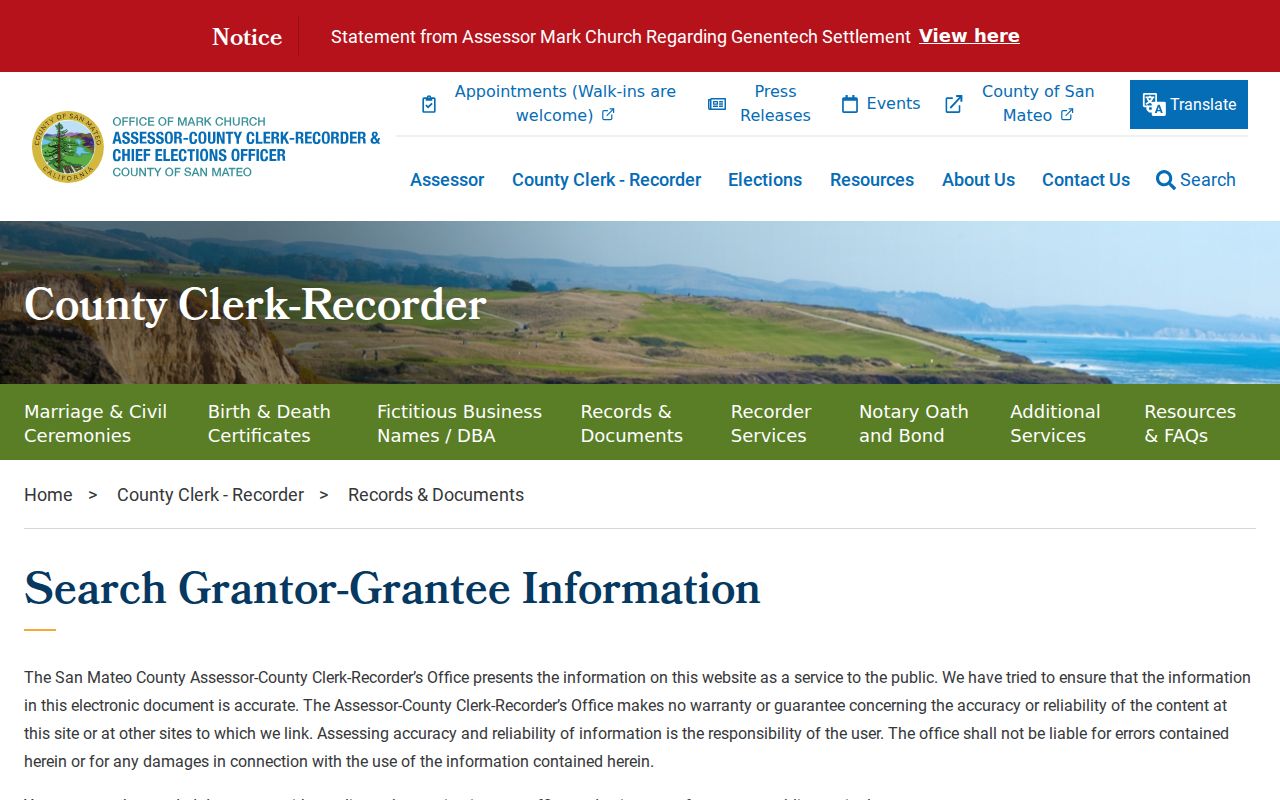
The index view points to the parties and instrument. The ordered document supplies the clauses, legal description, signatures, notary acknowledgment, and other details needed to test a chain.
When the San Mateo Previous Residents Index Stops
The ACRE web index does not publish its first indexed year, and the county expressly withholds document images from the online search for privacy reasons. That is a local research quirk, not a dead end. The index is free, public terminals are available, and a document can be ordered after its reference is captured. The Recorder Division can explain the available route without giving legal advice about the instrument.
For older material, ask for the record series, date range, document number, or legal description. The ACRE office is at 555 County Center, 1st Floor, Redwood City, and the Recorder contact listed in the research is (650) 363-4500. A request for an existing document is more useful than a broad question asking staff to reconstruct the entire history of a house.
Compare the index with the county map and the library shelf. If a party name has spelling variants, a trust name, a married name, or an abbreviated entity name, try each documented form. A no-hit result can reflect the wrong index direction, a changed parcel identity, an unindexed earlier series, or an incomplete name rather than an absence of previous residents.
Keep San Mateo Parcel Identity Through Changes
Street numbers and street names are not permanent identifiers. San Mateo historical maps, directories, subdivisions, and later permits can use different forms for the same place. Record three identities side by side: situs, mailing, and legal description. Situs is the physical location. Mailing is where tax or owner correspondence goes. Legal description identifies the land through a lot, block, subdivision, or surveyed description.
Use the APN as a bridge when an old address fails. County map workflows can search by address, APN, book and page, or parcel-map volume and page. The planning format is a nine-digit value displayed like 0XX-XXX-XX0 and searched without punctuation in the viewer. A mailing address that differs from the situs may suggest an owner lives elsewhere, but it does not identify every person at the property or prove who occupies it.
For older numbers, compare the 1897 Sanborn sheets, later 1920s-1930s sheets, directory street sections, and recorded subdivision maps. The research does not confirm a complete historical street-renumbering schedule. Treat a suspected change as a question to verify through maps and the custodian, not as a fact inferred from a modern address.
Find San Mateo Past Households in Directories
Directories supply the household layer that a deed cannot. San Mateo Public Library’s California Collection holds Polk, Haines, and other city directories covering 1907 to the present, searchable in print by personal name, business, and street address. The current collection description uses a broader “1900s-present” phrase, so confirm exact volumes and gaps with reference staff before promising an annual run.
Earlier entries may show a household head, spouse in parentheses, occupation, business, and home address. A “wid” notation may identify a widow. Later reverse or criss-cross directories can be read by street and number. The Library of Congress criss-cross inventory identifies San Mateo County reverse directories from 1976-1995. Those volumes can show a listed occupant or telephone subscriber, including people not named in title, but they can also omit unlisted customers, vacant homes, and names missed during canvassing.
The Main Library is at 55 W. Third Avenue. Its reference contact is (650) 522-7818 and smplref@plsinfo.org. Ask for the exact street, subdivision, variant spellings, and years. The San Mateo directory book page covers the collection shelf and entry conventions, while the previous residents workflow uses those books to test one address over time.
Pair San Mateo Directories With Census Years
Census schedules add household relationships and tenure at a particular enumeration. Federal schedules through 1950 have been released under the 72-year rule. A directory and a census rarely describe the same day, so the safest use is comparison. A person can move after a directory canvass and before a census visit, or a directory can carry a prior address for part of a publication year.
- Transcribe a directory entry exactly, including initials, spouse notation, occupation, address, and any abbreviation key used by that edition.
- Pair the entry with a released census year such as 1910, 1920, 1930, 1940, or 1950. Compare names, ages, relationships, occupation, and tenure.
- Check the next available directory and the street section. A vanished name may reflect a move, a gap in holdings, a changed number, or a new occupant.
- Use local newspapers, obituaries, marriage notices, school news, and probate to test family connections and dates.
- Keep ownership separate from occupancy. A census or directory association with a house does not prove the person held title.
Library databases can add HeritageQuest, HeritageHub, Ancestry Library Edition, and other genealogy routes, with access varying by location and card status. The record of a household is strongest when an address, date, and relationship agree across more than one source.
Date San Mateo Houses With Maps
Sanborn fire-insurance maps show the structure rather than its residents. The digitized July 1897 San Mateo edition contains six sheets. The Main Library holds later 1920s-1930s sheets. Compare footprint, construction material, use, street name, and number context before matching a directory entry. A map can show when a building existed or how a block changed, but it cannot name a household by itself.
City CSS supplies a more recent project trail. Search categories include Permits, Plans, Inspections, Code Cases, and Business Licenses. Address, date range, permit number, APN, and an interactive map can narrow the result. A finaled permit may date an addition, alteration, or demolition. Contacts in a permit are project participants, not proof of occupancy, ownership, or a complete list of previous residents.
When a house history reaches a gap, combine the building date from maps or permits with a directory year and a deed date. That three-part comparison helps distinguish a new structure from an old address label and keeps a later person from being placed in a building that did not yet exist.
San Mateo Unclaimed Property Clue
The California State Controller’s unclaimed-property search can surface an owner name and a last-known city or address clue. That clue may help connect a former San Mateo resident to a name variant, estate, or later research lead. It is not a deed, a residence record, or proof that a person lived at the target address. A result can be stale, incomplete, or tied to a different person with the same name.
Search the California unclaimed property database directly, then treat a match as a prompt to gather claim documentation and verify the person through a deed, directory, probate file, obituary, or other source.
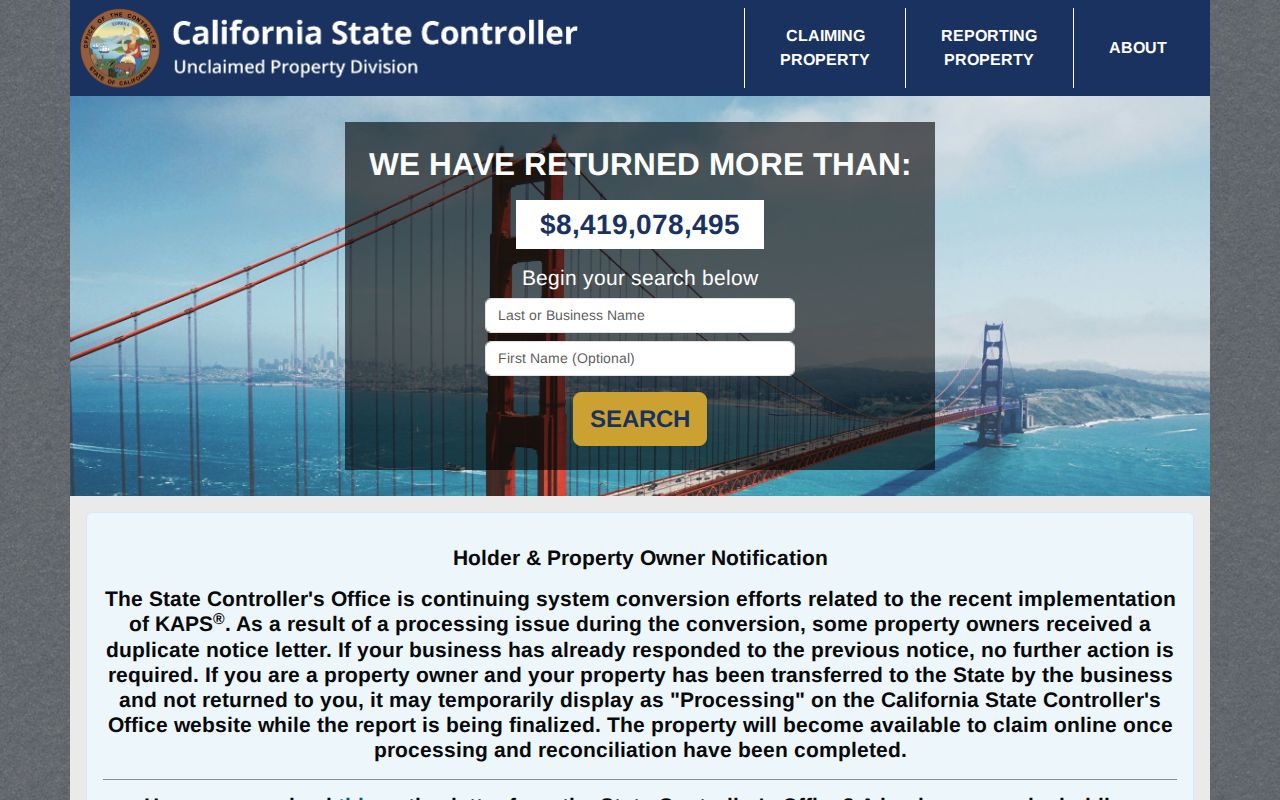
The Controller requires evidence for a claim. The name search alone should never close a previous residents trail or substitute for the custodian’s proof requirements.
Close a San Mateo Previous Residents Trail
Obituaries and probate can explain where a former household went, who the relatives were, and which person in a directory entry is the right one. The Main Library’s San Mateo Times microfilm begins in 1901, with older Gazette and News Leader film also available. Probate files at the San Mateo Superior Court may identify decedents, heirs, petitions, orders, and distributions. ACRE recorded documents can add a later transfer or probate-related instrument.
Search by the address and the person together. Preserve middle initials, spouse names, occupations, and dates. A similar surname in an obituary is a lead, not a confirmed identity. Use at least two stable joins, such as a directory address plus an obituary relationship, or a deed party plus a probate case number. Correct a source record through the office that created it; a directory or index cannot amend the original record.
Lawful house history. Previous residents research is appropriate for family history, genealogy, estate and heir work, reconnecting, and local history. Public availability does not permit stalking, harassment, intimidation, impersonation, or attempts to expose a protected person.
California’s Safe at Home program can shield eligible participants with a designated substitute mailing address, and confidential records may not appear in ordinary searches. A careful San Mateo house history records what each source proves, names what it cannot prove, and stops when privacy or record-access rules require it.