
San Mateo City Directory Shelves and Runs
The San Mateo Public Library California Collection is the main local starting point. Its detailed guide identifies Polk, Haines, and other San Mateo city directories from 1907 to the present, searchable by personal name, business, and street address. The current collection description uses the broader phrase “1900s-present,” so the years below describe verified coverage, not an uninterrupted annual run.
| Collection | Years | Where Held | Access |
|---|---|---|---|
| Polk, Haines, and other San Mateo city directories | 1907-present, gaps to verify | Main Library California Collection | Print reference; name, business, and street searches |
| Burlingame, Hillsborough, San Mateo city directory | 1929 | FamilySearch catalog | Catalog record; image access may vary |
| San Mateo and Burlingame directories | 1907-1909, 1926, 1929, 1931 context | National Archives directory inventory | Holdings and microfilm inquiry |
| San Mateo County criss-cross directories | 1976-1995 | Library of Congress address-directory inventory | Institutional access; verify local copy |
| San Mateo telephone directory example | 1948 | Library or archival telephone-book holdings | Reference or institutional scan; verify edition |
The 1929 volume is an exact, named holding, while the National Archives entry supplies a circa-1930 context for several San Mateo and Burlingame issues. A missing year may reflect a shelf gap, a publisher change, an unscanned volume, or a run that was never issued. Ask the reference desk to check the physical sequence before treating a blank year as a break in a family’s residence.
Where San Mateo Directories Are Held
The Main Library reference collection is at 55 W. Third Avenue. Reference help is available at (650) 522-7818 and smplref@plsinfo.org. A librarian can confirm a street section, publisher, or missing edition before a visit. The local shelf is especially useful because the directory, newspaper microfilm, clipping file, maps, and image collections sit within the same research route.
The San Mateo County Libraries genealogy resources page adds database access with different rules: Ancestry Library Edition is available in the library or on library Wi-Fi, while HeritageQuest and HeritageHub may be available remotely to qualifying cardholders. My China Roots can help with Chinese family, immigration, burial, and clan research. These tools supplement, but do not replace, the printed San Mateo run.

The library image reflects a research shelf that combines directories with genealogy databases. Confirm the access rule for each database before relying on a remote login or planning an onsite search.
Polk, Haines, and San Mateo Directory Years
Publisher names help sort editions, but a San Mateo directory is still a local snapshot. Polk and Haines volumes form the named local series. The exact 1929 title is Burlingame, Hillsborough, San Mateo city directory, 1929, published by Directory Publishing Company. Its catalog record is verified, while an unrestricted page image of a named resident entry was not available through the inspected institutional pages.
The FamilySearch catalog record for the 1929 directory is useful for confirming the title and place coverage. Image access can depend on account, permissions, or an affiliated library. Treat a catalog entry as proof that the volume is described, not as proof that every page is open online.
The 1929 catalog view anchors the San Mateo search to a real edition and publisher. The physical volume or an authorized image is still needed to read a particular household entry.
The National Archives city-directory inventory adds 1907-1909, 1926, 1929, and 1931 context for San Mateo-area holdings. The 1948 telephone directory example is a different source: it may list subscribers and numbers, but not every resident or every household.
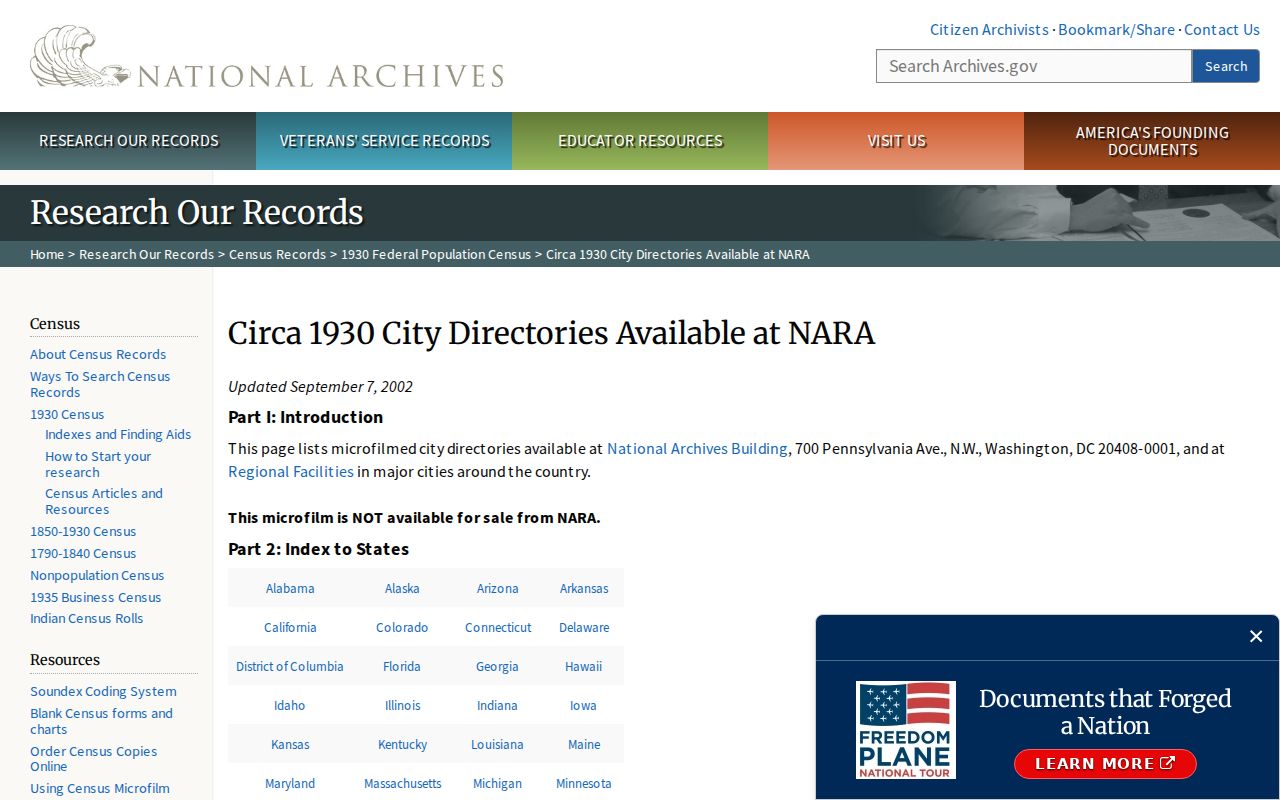
Archive-level listings show where a San Mateo directory volume may be found, while the library shelf remains the practical place to test names, streets, and year-to-year gaps.
Note: The official sources do not publish a complete uninterrupted volume list, so confirm each requested year with the holding institution.
Read a San Mateo Directory Entry
A directory entry is a set of clues with a date and an address. The household head is often alphabetized by surname. A spouse may appear in parentheses, a widow notation may name a deceased spouse, and an occupation or business may supply a second identity check. The street address can connect the name to a map or another edition, but publication lag and canvass limits mean the entry does not prove presence every day.
| Name | Surname, given name, and initials; preserve spelling and suffixes. |
|---|---|
| Spouse or family clue | Often in parentheses; “wid” may identify a widow and a deceased spouse. |
| Occupation | Occupation, trade, or business name when supplied by that edition. |
| Address | House number and street; a separate business address may also appear. |
| Owner or renter mark | Check the edition’s key for any occupancy symbol; a universal local mark is not confirmed. |
| Telephone or institution | Some volumes add a number, business, or institutional affiliation. |
Directory glossary.
- Criss-cross directory
- A reverse directory arranged by street and number, often leading from an address to a listed occupant or telephone subscriber.
- Householder index
- A name-oriented section that points to the household head or principal listing, not every person at the address.
- Abbreviation key
- The volume’s own legend for marks such as h, r, emp, clk, and wid; photograph or transcribe it before reading entries.
- Directory convention
- A common field pattern supported by the local-era genre, which still must be checked against the edition in hand.
San Mateo Criss-Cross Directories by Address
The Library of Congress criss-cross inventory identifies a San Mateo County reverse-directory run from 1976 through 1995. These books reverse the usual name-first search: start with a street, find the house number, and read the listed occupant or telephone subscriber. They are especially useful when a family name is uncertain or an older address is the best lead.
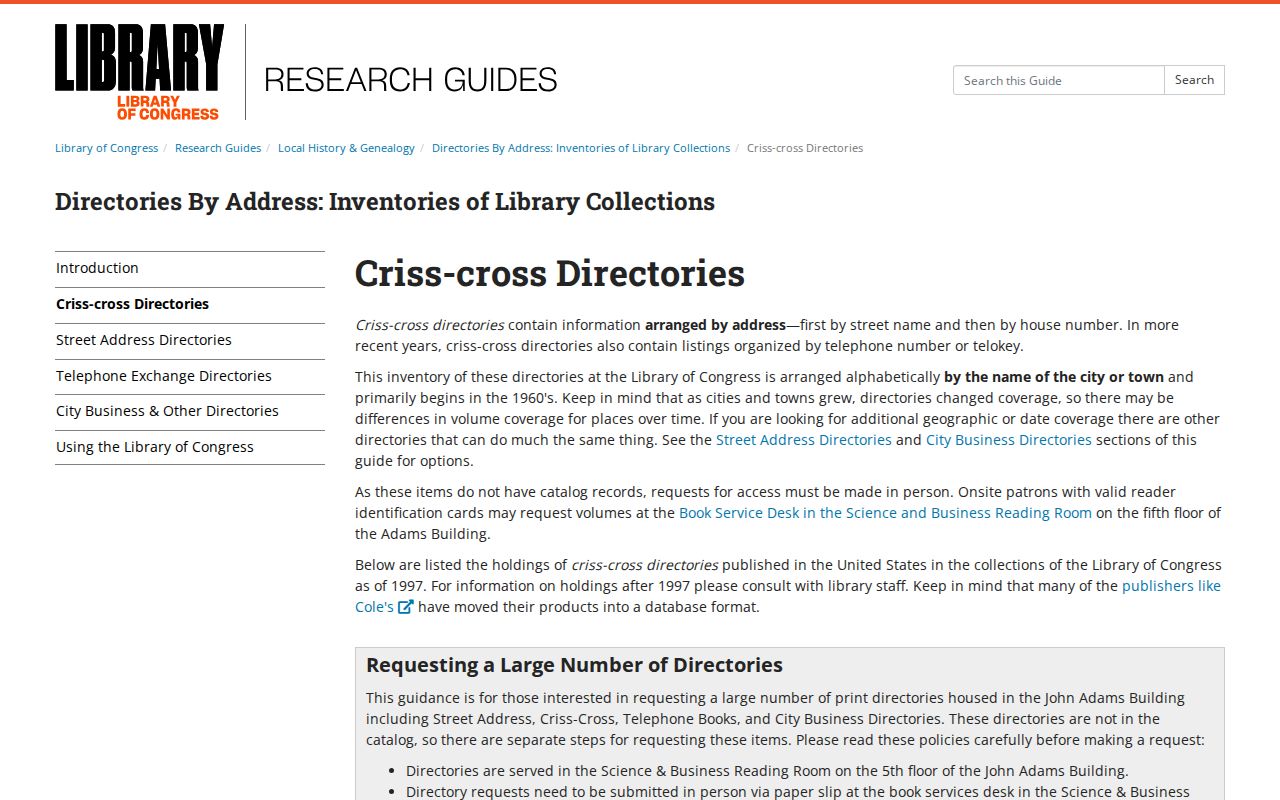
The reverse-directory inventory shows why a reverse directory can bridge modern parcel records and older name-alphabetical volumes. Unlisted numbers, delayed canvassing, name variants, and vacant structures remain possible, so pair a criss-cross hit with a deed, newspaper, or later directory.
San Mateo Newspapers Around the Directory
Directory entries become more useful when a newspaper supplies the event behind an address change. The Main Library holds San Mateo Times microfilm from 1901 forward, along with older San Mateo Gazette and San Mateo News Leader film. A clipping file emphasized for the 1940s through the 1960s can save time when a surname, school, club, business, or street is known but a page-by-page scan has no easy search.
The San Mateo County Historical Association adds photographs, documents, objects, exhibitions, and county-history expertise. Its collections and the Online Archive of California can supply context for a person, business, neighborhood, or organization. A newspaper notice may connect relatives or explain a move, but it should be checked against the dated directory entry and the record’s own role.
Historical Association collections widen the San Mateo directory trail beyond a name list. Use the image and catalog description as a lead, then verify dates, names, and addresses in the original holding.
San Mateo Sanborn Maps for Directory Clues
The Library of Congress 1897 San Mateo Sanborn map is digitized as six sheets. The Main Library holds later 1920s and 1930s Sanborn sheets. Maps show building footprints, construction materials, uses, street names, numbers, and changes in the built setting. They identify a structure, not the people who occupied it, so a map clue belongs beside a directory entry, deed, or newspaper.
Sanborn sheets are valuable when an old number does not match a modern address. Compare the footprint and street name first, then preserve the historical form of the address in the research notes. For current parcel and address-keyed records, the San Mateo Street Directory route is the better handoff; the historical volume remains the source for the older household clue.
Note: A map can date a structure and clarify street context, but it cannot by itself establish a resident’s identity or tenure.
Trace Family Through San Mateo Directories
For family history, begin with the most certain name and year, then carry the address, spouse, occupation, and spelling into each nearby edition. Federal census schedules released from 1790 through 1950 give decade anchors for a directory trail. A directory proves a published association, not legal ownership or continuous presence.
- Find the first reliable name entry and copy every field, including initials, spouse clue, occupation, and address.
- Check the next and prior available editions; note moves, publisher changes, missing years, and altered street forms.
- Use a street or reverse section when present, especially after the name disappears or a family member takes over the address.
- Pair the directory observations with the 1910, 1920, 1930, 1940, and 1950 census schedules, allowing for different enumeration and publication dates.
- Close an uncertain trail with newspapers, obituary and cemetery clues, probate records, or a later family record, keeping same-name people separate.
When a name vanishes, test three explanations: the household moved, a person died, or the edition omitted the listing. HeritageHub and local newspaper film can reconnect family branches and heirs, while the library’s clipping file can reveal a school, club, or community link. If a historical entry needs a current identity check, use the official records route rather than treating the directory as proof.
A San Mateo Library Story
The local library’s history explains why the San Mateo directory shelf is so valuable. The Ladies Guild of St. Matthew’s Episcopal Church began a reading-room effort in 1883. Library Hall opened in 1885 and burned on April 6, 1887. The city assumed the association property in 1899 and opened a free library with 4,000 volumes. A Carnegie library followed in 1907, the same year identified by the detailed library guide as the first verified local-directory year.
| 1883 | St. Matthew’s Guild begins the reading-room effort tied to the local library story. |
|---|---|
| 1887 | Library Hall burns on April 6, creating an important institutional break. |
| 1899 | The city opens a free library with 4,000 volumes after assuming the association property. |
| 1901 | San Mateo Times microfilm begins in the library’s local newspaper route. |
| 1907 | The Carnegie library opens and the detailed directory guide begins its verified local run. |
| 1929 | Directory Publishing Company issues the named Burlingame, Hillsborough, San Mateo volume. |
| 1976-1995 | The Library of Congress inventory records a San Mateo County criss-cross directory era. |
Note: The 1887 fire is a library-history event, not evidence that county deed books or resident records were destroyed.
Plan a San Mateo Directory Visit
Start with the Main Library reference desk and ask for the exact street, surname variants, subdivision name, and years needed. The California Collection can place directories beside newspapers, clippings, maps, and photographs. Ask whether a volume is print, microfilm, a bound reference copy, or held elsewhere. The library’s phone and email route is the fastest way to test a gap before travel.
For broader genealogy, use county-library database rules, the FamilySearch catalog, NARA’s directory inventory, and the Library of Congress address-directory guide. FamilySearch may require a free account or an Affiliate Library for images. The California State Archives collections and the Historical Association can point to government or county material, while census schedules can be searched through NARA, FamilySearch, or qualifying library databases. No complete volume-by-volume inventory or universal digitization claim is supported by the available sources.
Note: Label a field list as a directory convention until the physical or authorized image of that San Mateo edition has been inspected.